News
Sep. 29, 2026

From 23 to 26 September 2026, FENGXIANG / FUMA FOOD MACHINE exhibited at Booth 2D08, MITEC, Kuala Lumpur during the 22nd Malaysia International Halal Showcase (MIHAS 2026), organised by MATRADE under Malaysia's Ministry of Investment, Trade and Industry.
We brought five machines. We ran them all day. And by the time the show closed, two of them had been sold straight off the booth floor — the flip-type washing machine and the tabletop fruit peeling machine.
This is our recap: what we showed, who we met, what Malaysian food processors actually asked for, and where the market is heading.
MIHAS is not a general machinery fair. It is a focused halal trade platform, and that changes who walks past your booth.
MIHAS 2026 covered 2,000 booths with 1,700 exhibitors and 450 international buyers from 58 countries, targeting 50,000 business visitors — 30,000 of them through the doors by day two alone. The show has generated more than RM35.0 billion in export sales since 2004, and this edition's International Sourcing Programme arranged over 4,000 pre-scheduled meetings between Malaysian exporters and overseas buyers.
(Source: MATRADE / Media OutReach, 23–26 September 2026.)
For a machine builder, the practical value is simple: buyers arrive with a product already in production and a capacity problem they have to solve. Very few visitors are "just browsing".
| Machine | What it Does | Typical applications |
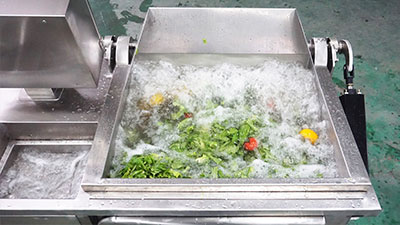
Flip-Type Washing Machine
| Tumbling/flip washing for fruits, vegetables, corn and grains | Root vegetables, corn, grains, leafy produce, high-volume pre-washing before cutting |
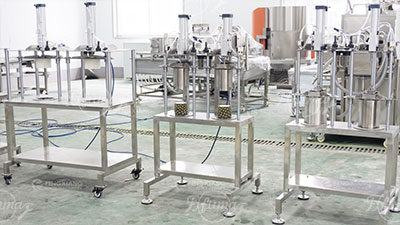
Pineapple Peeling & Coring Machine
| Removes the skin and punches out the core in one pass | Fresh-cut pineapple, cannery prep, dehydration lines |
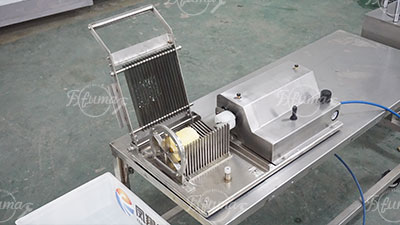
Pineapple Ring Slicing Machine
| Cuts peeled, cored fruit into uniform rings | Canned rings, fresh-cut trays, dried pineapple |
Pineapple Ring & Wedge Cutting Machine
| Cuts rings and splits fruit into wedges/segments | Retail trays, juice prep, foodservice |
Tabletop Fruit Peeling Machine
| Peels melon, pineapple, mango, papaya, small winter melon, and brown coconut | Fresh-cut shops, juice bars, central kitchens, small processors |
The line-up was deliberately practical rather than showy. Four of the five machines were built around a single crop — pineapple — because pineapple is where Malaysia's processing demand is most concentrated. The fifth, the flip-type washer, is the machine almost every fruit and vegetable processor needs at the front of the line.
Live demonstrations did the selling. Visitors rarely trust a spec sheet. What convinced them was watching the peeling and coring machine strip and core a fruit in one pass, then picking up the output and inspecting it themselves. Both machines we sold on site were sold this way — after a demo, not after a brochure.
Two machines went home with customers. The flip-type washing machine and the tabletop fruit peeling machine were both purchased at the show and taken away directly from the booth. Both are entry-level, single-operator machines — the kind a processor buys when they have already decided to move a manual step to automation, and simply needed to see it work once.
The buyers were specific. The people who stopped at Booth 2D08 were mostly:
● Fresh-cut and minimally processed fruit and vegetable producers
● Pineapple and tropical fruit processors, including cannery-linked operations
● Juice and beverage manufacturers
● Coconut product processors
● Foodservice and central kitchen operators
● Machinery importers and distributors serving the Malaysian market
● Buyers from other countries attending MIHAS' international sourcing programme
The questions were remarkably consistent. Almost every serious conversation came back to four points: capacity per hour, how many operators it needs, how easy it is to clean and sanitise, and whether spare parts are available locally. Consumers of this feedback, those four questions became our shortlist for what to prioritise in the next product revision.
Based on four days of conversations, five requirements came up repeatedly:
● Less dependence on manual labour. Labour availability and cost continue to be the single biggest driver of automation decisions. Several visitors described turning down orders because they could not staff the prep line.
● Consistent cut quality. Retail and export buyers reject inconsistent sizing. Machines are increasingly bought to standardise output, not just to speed it up.
● Hygiene and easy cleaning. Stainless steel construction, smooth surfaces, and fast teardown for cleaning are treated as non-negotiable — particularly for processors working within halal supply chains, where handling and cleanliness standards are audited.
● Right-sized equipment. Most Malaysian processors are not buying fully processing lines. They are buying one or two machines to remove a specific bottleneck, then adding the next machine when volume justifies it.
● After-sales and parts. "Who fixes it, and how fast?" is asked earlier in the conversation than price in many cases.

This matches our own product focus: single machines that solve one bottleneck, that can later be connected into a line.
If you recognise yourself below, we build for you:
● Fresh-cut / minimally processed fruit and vegetable producers — peeling, coring, ring and wedge cutting, washing and drying
● Pineapple and tropical fruit processors — peeling, coring, ring slicing, wedge cutting, dried and canned product prep
● Juice, beverage and coconut water manufacturers — fruit prep and washing at the front end of the line
● Canneries and frozen fruit exporters — standardised sizing and high-throughput prep
● Dried fruit and snack producers — uniform slices and rings for consistent dehydration
● Central kitchens, foodservice and catering operations — compact, single-operator machines
● Coconut and mango processors — peeling, dicing and shredding equipment
● Food machinery importers and distributors — a full single-machine catalogue plus customised production line

We build single machines and complete fruit and vegetable processing lines, backed by 20 years of manufacturing experience, a 3,800 m² factory, and 30+ patents.
MIHAS 2026 confirmed something we already suspected: in Southeast Asia, the decision to automate is no longer about whether, but about which machine first.
If you stopped by Booth 2D08, thank you — it was good to meet you, and any follow-up questions about the machines are welcome at any time.
If you did not make it to the show, we can do exactly what we did on the booth floor in a video call: show the machine running on your product, and quote on your capacity requirement.
Tell us the fruit or vegetable you process and your target output per hour, and we will recommend the right machine or line — including the pineapple peeling, coring, and ring-cutting combination that drew the most attention at MIHAS 2026.
FUMA New Arrivals
FKP-25 Frozen Meat Slicer Meat portion cutter with conveyor
Horizontal meat cutting machine can be applied to slice frozen meat blocks, bacon, sausages, cheese, beef steak, and so on, whose thickness can be adjusted digitally and precisely. Portion can meet users' demands. The cutting thickness of the meat can be adjusted.
XQPJ-160 Industrial Continuous Meat Slicer Machine
The continuous meat slicer is a kind of meat-cutting equipment that can continuously feed and cut meat materials. It can be used for cutting various meat raw materials such as snowflake fatty beef, cooked beef and mutton, chicken breast, sausages, cured meat, bacon, ham, streaky pork, pork, etc.
Pig trotters middle splitter Pork knuckle dividing machine
The principle of the pig's trotter splitting machine is that two rotating conveyor belts clamp the pig's trotters by relying on friction and driving them to move toward the bone saw blade. When the pig's trotters reach the position of the bone saw blade, the bone saw blade running at a high speed cuts them.
During operation, you only need to manually place the ingredients in a specific position. The machine will automatically feed the skewers and position them, accurately threading the ingredients onto the skewers. This type of skewer machine can improve the skewer threading efficiency, reduce the labor intensity of manual work.